Bedding · Wool Bedding Guide
Healthy Choice and Sleep & Beyond: Finding the Right Wool Bedding Weight
A wool comforter can feel wonderfully breathable—or unexpectedly warm—depending on its fill, your bedroom, and the way you sleep. Comparing lighter and heavier options is less a matter of finding a universal “best” and more an exercise in matching insulation to the night you actually live in.
There is a particular sort of domestic arithmetic that takes place at bedtime. The thermostat says one thing; the room, with its drafty window or sun-warmed wall, says another. A sleeper who calls the bed too hot may still reach for a blanket at three in the morning. A partner who sleeps cold may regard the same comforter as an unnecessary expedition into the tropics. Wool, with its reputation for balancing warmth and breathability, seems to offer a tidy solution. But the fiber alone cannot settle the question. The weight of the fill matters, as do the shell, the construction, care requirements, and the small personal fact of whether you tend to sleep warm or cold.
That is why a useful wool bedding weight guide begins not with a product label but with the bedroom. Healthy Choice and Sleep & Beyond offer wool comforters in lighter and more substantial configurations, giving shoppers a practical way to think about insulation. The comparison is not simply light versus heavy. It is a comparison of fill density, fabric, quilting, maintenance, and the climate in which each comforter will spend its nights.
Start with the room, not the adjective
“Lightweight” and “medium weight” are helpful descriptions, but they are not complete predictions of how warm a bed will feel. A room’s temperature changes over the course of the night. So does the sleeper beneath the covers. Heating may switch off, a window may admit cool air, or another person may add an extra layer of warmth. Even the bedding underneath a comforter affects the impression: flannel sheets and a thick mattress pad create a different starting point from crisp percale and a minimally layered bed.
Think first about the nights that make you uncomfortable most often. If you wake warm, push the covers aside, or live in a consistently mild or warm bedroom, a lighter fill may be the sensible place to begin. If you regularly feel cold under ordinary covers, keep the room cool, or find that winter bedding still leaves you searching for another layer, a denser fill may be more appropriate. The aim is not to make the bed as warm as possible. It is to give it enough insulation to feel comfortable without turning it into a sealed little weather system.
It helps to observe the pattern over several nights rather than rely on one unusually warm evening. Note the season, the room temperature if you can, what you wear to bed, and whether you tend to sleep warm or cold. A short record may reveal that a comforter feels perfect in autumn but too warm in a heated room, or that a lighter option suits most of the year and needs only a blanket during colder spells. This sort of plain observation can be more useful than trying to infer comfort from a single number.
What fill weight tells you—and what it does not
Fill weight describes how much filling is used in a given area or in an entire comforter. It is a useful point of comparison, especially when the specifications are presented in comparable units. The Healthy Choice options provide a clear example: the Healthy Choice Lightweight Organic Wool Comforter is listed at 150 grams per square meter, while the Healthy Choice Medium Weight Organic Wool Comforter is listed at 350 grams per square meter. The latter uses substantially more wool per square meter and is described as intended for colder conditions.
Those figures help explain why the two options may feel different, but they should not be mistaken for a universal warmth scale. Fill weight alone does not account for the dimensions of the comforter, how the batting is distributed, the cover fabric, the quilting, or the conditions in which it is used. Nor should a number from one maker be compared casually with a number from another unless the manufacturer explains the measurement in a compatible way. In practical terms, the specification is a clue; the construction and the intended use complete the picture.
Sleep & Beyond describes its myComforter Light as a lighter option, with wool fill listed at 5 ounces per square yard. The lighter version is presented as suitable for warm seasons or climates, or for people who keep a cool bedroom but prefer only a touch of cozy warmth. The myComforter, by comparison, is described as a year-round wool comforter with 13 ounces of fill per square yard. These figures offer a basis for comparing the two Sleep & Beyond models within their own range, while the stated use cases help translate them into everyday decisions.
There is no need to treat the label “all-season” as a promise that a comforter will suit every climate, sleeper, and month of the year. It is a description of intended versatility, not a personal fitting. Someone in a well-heated apartment who sleeps warm may prefer a lighter configuration even in winter. Someone in a cooler room may find a medium or year-round weight more comfortable. The room and the sleeper remain the final judges.
Healthy Choice: a distinct step between lighter and medium
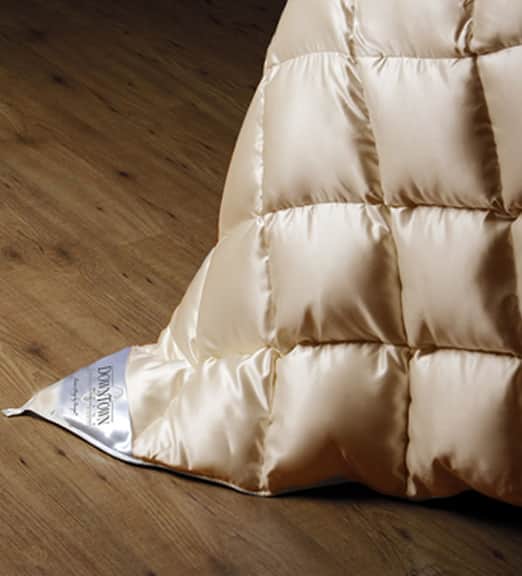
The Healthy Choice range makes the weight distinction especially legible. Its lightweight organic wool comforter is filled with 150 grams per square meter of wool and has an organic cotton sateen cover. The product information describes it as a fit for people in warm climates, warm sleepers, and anyone seeking a lighter layer. The quilted dotted pattern helps keep the fill distributed, while the stated dimensions cover twin, double, queen, and king sizes.
The medium-weight Healthy Choice comforter uses 350 grams per square meter of pure organic wool, again under an organic cotton sateen cover. It is positioned for colder conditions, including nights when temperatures approach freezing. A wave-pattern quilting design is described as helping hold the wool evenly in place. The extra fill is the meaningful difference between these two options: one is intended to reduce insulation; the other offers a more substantial layer for a colder setting.
Both descriptions emphasize breathable materials and wool’s capacity to manage moisture. That does not mean either comforter can regulate a bedroom’s temperature on its own, or that every sleeper will experience it in the same way. It means the material and construction are intended to support a comfortable sleep environment rather than simply trap as much heat as possible. If your room is warm and you already use substantial sheets or blankets, the lighter option may make more sense. If you are often cold despite moderate layers, the medium weight is the more plausible starting point.
Care is another point of difference worth considering before purchase. The Healthy Choice care guidance advises against washing the comforters, recommending spot cleaning with a small amount of water and mild soap, followed by air drying. It also suggests airing the comforter outdoors twice a year and using a duvet cover to help keep it clean. The instructions matter: a comforter that is difficult to wash may still suit a household, but it is best to understand its maintenance before a spill becomes an occasion for improvisation.
Sleep & Beyond: lighter wool, with a care routine to understand
Sleep & Beyond’s light and regular myComforter options also use wool, but their product descriptions foreground a slightly different balance of fill weight, shell, and care. The myComforter Light is listed with 5 ounces of wool fill per square yard and a 100% cotton sateen cover. It is pitched toward warm seasons, warm climates, and people who want less insulation. The standard myComforter is listed at 13 ounces per square yard, with a natural cotton sateen cover, and is presented as a warmer year-round choice.
Both product descriptions describe wool as breathable and moisture-wicking, and recommend a duvet cover as protection. The lighter model is particularly relevant if you want the feel of wool without a dense layer. The standard model may suit someone who wants a more substantial comforter but still values wool’s airier, moisture-managing qualities. In either case, the distinction is not merely about the season printed on the label. It is about how much insulation feels comfortable in your bedroom and how much layering you want to do.
Sleep & Beyond’s care guidance is more permissive in one respect: it says the comforters can be machine washed in cool or warm water on a wool or delicate cycle, without agitation, using an approved wool detergent. The instructions also say not to spin, and to air dry or tumble dry on low heat. At the same time, the guidance discourages frequent washing because the batting may separate inside the quilted pockets. For major stains, it recommends professional cleaning on a short, low-moisture cycle.
These directions should be read as model-specific guidance, not as a general rule for all wool bedding. Wool comforters vary in how their fibers are processed, how the batting is held in place, and what their makers consider safe care. Follow the label supplied with the item you own. If instructions differ between a product page and a care label, confirm the recommended method with the manufacturer or retailer rather than assuming that a machine-washable wool comforter can tolerate every washer and cycle.
The shell and quilting are part of the decision
When comparing wool bedding, it is easy to become absorbed in fill weight and overlook the fabric surrounding it. Both Healthy Choice and Sleep & Beyond describe cotton shells; the Healthy Choice models specify organic cotton sateen, while Sleep & Beyond describes cotton sateen covers in the product information. The shell touches the sleeper and contains the fill, so its hand, breathability, and construction contribute to the overall experience. A soft, familiar cotton cover may be appealing, but weave and finish can also affect how the comforter drapes and feels against other bedding.
Quilting is less decorative than it may appear. Its practical job is to help prevent the filling from migrating and collecting in one area. Healthy Choice describes a dotted pattern on its lightweight model and a wave pattern on its medium-weight version. Sleep & Beyond describes quilting intended to keep the wool batting from shifting. Differences in stitching do not, on their own, establish which comforter is warmer or more durable; they are part of the construction to consider alongside the fill and the maker’s care instructions.
Size deserves the same attention. A comforter that fits the bed differently from your existing duvet cover may shift, bunch, or leave too little drape at the sides. Compare the actual dimensions, not only the size name. Twin, queen, and king labels are not always used identically by every maker, and Sleep & Beyond lists some sizes in measurements that differ from the Healthy Choice dimensions. If you plan to use a duvet cover, check both the insert and cover measurements and look for corner ties or other fastening details that will keep them together.
A duvet cover is a small, useful form of protection
For wool bedding, a removable duvet cover is more than a styling choice. It creates a washable barrier between the comforter and ordinary soil, helping reduce the need to clean the insert itself. That matters especially for models whose care instructions favor spot cleaning or discourage frequent washing. A cover can also make it easier to change the feel of the bed by season without changing the comforter beneath it.
Choose a cover that fits the insert closely enough to avoid excessive movement and that has compatible ties if the comforter includes loops or attachment points. Launder the cover according to its own instructions, and let the insert air periodically if the manufacturer recommends it. Fresh air can help bedding feel refreshed, though direct sun exposure and cleaning practices should follow the specific care guidance for the item. A cover does not eliminate the need for care, but it can make care more manageable—and protect an investment from the ordinary life of a bedroom.
A practical comparison before you choose
The following checklist brings the main distinctions into one place. It is not a ranking; it is a way to make the comparison less abstract.
- For a warm room or warm sleeper: consider the Healthy Choice lightweight model at 150 g/m² or Sleep & Beyond myComforter Light at 5 oz per square yard.
- For a colder room or a sleeper who runs cold: compare the Healthy Choice medium model at 350 g/m² with Sleep & Beyond myComforter at 13 oz per square yard, then consult each maker’s intended-use guidance.
- For lower-maintenance routines: read the care instructions closely. Healthy Choice recommends spot cleaning and airing; Sleep & Beyond gives specific, limited machine-washing directions for its wool models.
- For a duvet-cover setup: check insert dimensions, cover dimensions, and attachment details before buying. A good fit can reduce bunching and make the bed easier to maintain.
- For uncertain climates: consider whether you would rather use one medium layer or build warmth with a lighter comforter and a separate blanket. Layering offers flexibility, though it may add bulk.
It is also worth separating a preference for weight from a preference for warmth. Some people enjoy the reassuring drape of a heavier bed even when they do not need much insulation; others find a light layer more comfortable regardless of the room temperature. If possible, pay attention to both sensations. Does the comforter feel too hot, or simply too substantial? Does a lighter layer leave you cold, or does it feel pleasant until the room gets chilly? Those answers point toward different solutions.
The economical choice is the one that fits your nights
A lower price is not a saving if the comforter spends most of the year folded in a closet. Budget-conscious bedding shopping means comparing use, construction, and care alongside the initial cost. A lighter comforter used comfortably across most of the year may be a better fit than a heavier one that requires extra seasonal storage. Conversely, a medium-weight option that eliminates repeated purchases of additional blankets may make sense for a cold room. Longevity, care effort, and how often you expect to use the item all belong in the calculation.
Specifications can narrow the field, but no fill-weight figure can promise a particular night’s sleep. The Healthy Choice lightweight and medium options offer a pronounced contrast in wool quantity per square meter; Sleep & Beyond’s light and standard myComforter models offer their own distinct fill levels and care directions. Compare each maker’s measurements within its range, then use the intended climate and care details to decide which option deserves a closer look.
In the end, the right wool comforter is not necessarily the loftiest or the most substantial. It is the one that leaves room for the body to settle, the bedroom to remain comfortable, and the sleeper to stop negotiating with the covers. Begin with your room temperature and your own habits. Then compare fill weight, shell, quilting, size, and care instructions. That sequence—unhurried, practical, and attentive to the conditions of your own bed—is a more reliable guide than any promise printed on a label.
At a glance
If you sleep warm or keep a warm bedroom, start with a lightweight wool comforter. If you sleep cold or have a persistently chilly room, examine the more substantial fill options. Healthy Choice provides listed fill weights of 150 g/m² for its lightweight comforter and 350 g/m² for its medium-weight version. Sleep & Beyond lists 5 oz per square yard for myComforter Light and 13 oz per square yard for myComforter. Because care recommendations differ, check the specific product guidance before buying—and protect the insert with a duvet cover if its design allows.